Zareth Irwin, MD · Leadership, Executive & Physician Coach · Irwin Clarity Coaching
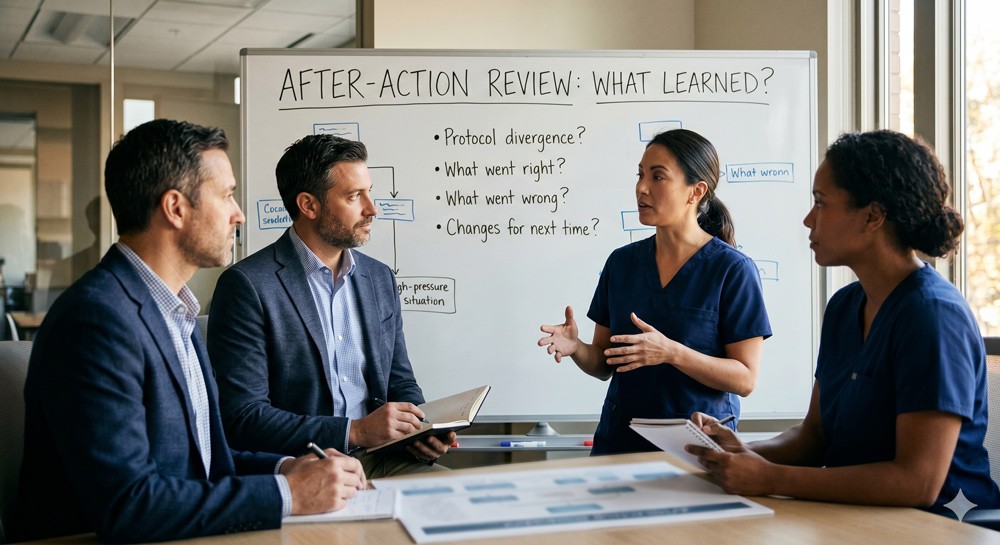
After a resuscitation- whether the outcome was good or bad- the team would debrief. Not immediately, and not every time, but it was always valuable. We would have a moment of celebration if the outcome was good, or silence if the outcome was bad. We would walk through what happened: the sequence of events, the decisions made, the moments where the protocol diverged from the plan. Everyone had a voice. What worked? What didn't? Would we do anything differently next time? And then we would go back to work. No blame assigned. No careers ended. Just the disciplined, honest act of learning from what had just happened so that the next patient would benefit from it. In medicine, we called this the debrief. In most organizations, there is no equivalent. And that absence costs more than most leaders realize.
Why High-Stakes Fields Debrief
Aviation, special operations, emergency medicine, competitive athletics — the fields that operate in high-stakes, high-consequence environments almost universally practice some version of the after-action review. When the cost of error is high and situations are complex, learning must be systematic. You cannot afford to let experience accumulate without extracting its lessons deliberately.
The military After Action Review (AAR) is one of the most rigorously studied organizational learning tools in existence. Its core structure is deceptively simple: what was supposed to happen, what actually happened, why the difference, and what do we do differently next time. Four questions. Applied honestly, consistently, without rank pulling seniority over truth.
What Organizations Do Instead
The organizational alternatives to the debrief are, broadly, three. The first is the post-mortem: a retrospective that happens only after catastrophic failure, conducted under conditions of stress and self-protection, often with more attention to assigning accountability than to generating learning. The second is the informal hallway conversation — genuine learning that stays private, never reaching the people or systems that most need it. The third is silence.
None of these produce the systematic organizational learning that the debrief does. The post-mortem arrives too late and under the wrong conditions. The hallway conversation doesn't scale. Silence compounds error — the same missteps repeat themselves in the next initiative, the next quarter, the next team, because no one ever made the lessons explicit.
What Makes a Debrief Work
1 SEPARATED from consequences
The debrief is not a performance review. Nothing said in it can be used against you in an evaluation. The explicit purpose is learning, not judgment. Without this separation, people protect themselves rather than tell the truth.
2 RANK is suspended
The attending physician does not get to be right just because they are the attending. The nurse who noticed something fifteen minutes before anyone else speaks up, and that observation is treated as data. Hierarchy organizes execution. It should not organize learning.
3 ROUTINE, not exceptional
The debrief happens after significant cases -not just the ones that went badly. When review only happens after failure, it becomes associated with blame. When it happens routinely, it becomes associated with growth.
4 SPECIFIC and behavioral
Not 'communication could have been better' — but 'when the blood pressure dropped at minute seven, there was no verbal confirmation from the team that the medication had been given.' Vague feedback produces vague improvement.
5 LOOKS at what went right as well
The debrief is not only a catalog of failure. It identifies what worked, explicitly, so those behaviors can be reinforced and repeated. High performance is built on understanding success as much as failure.
The Leadership Cost of Skipping It
There is a particular exhaustion that sets in on teams that work hard, move fast, and never stop to learn from what they have done. They get competent at the mechanics of execution without ever developing the reflective capacity that would make them genuinely excellent. Every new challenge arrives as if it is the first one. The same dynamics repeat. The same blind spots persist.
The debrief is the practice that turns experience into learning, learning into competence, and competence into culture. It does not require a formal process or a two-hour meeting. It requires a leader who is willing to stop, look honestly at what just happened, invite the truth from the people closest to it, and treat what they hear as information rather than verdict.
When did your team last sit down and honestly ask:what did we just learn from what we just did?The debrief is not a meeting. It is a culture.And it starts with the leader being willing to go first. |